
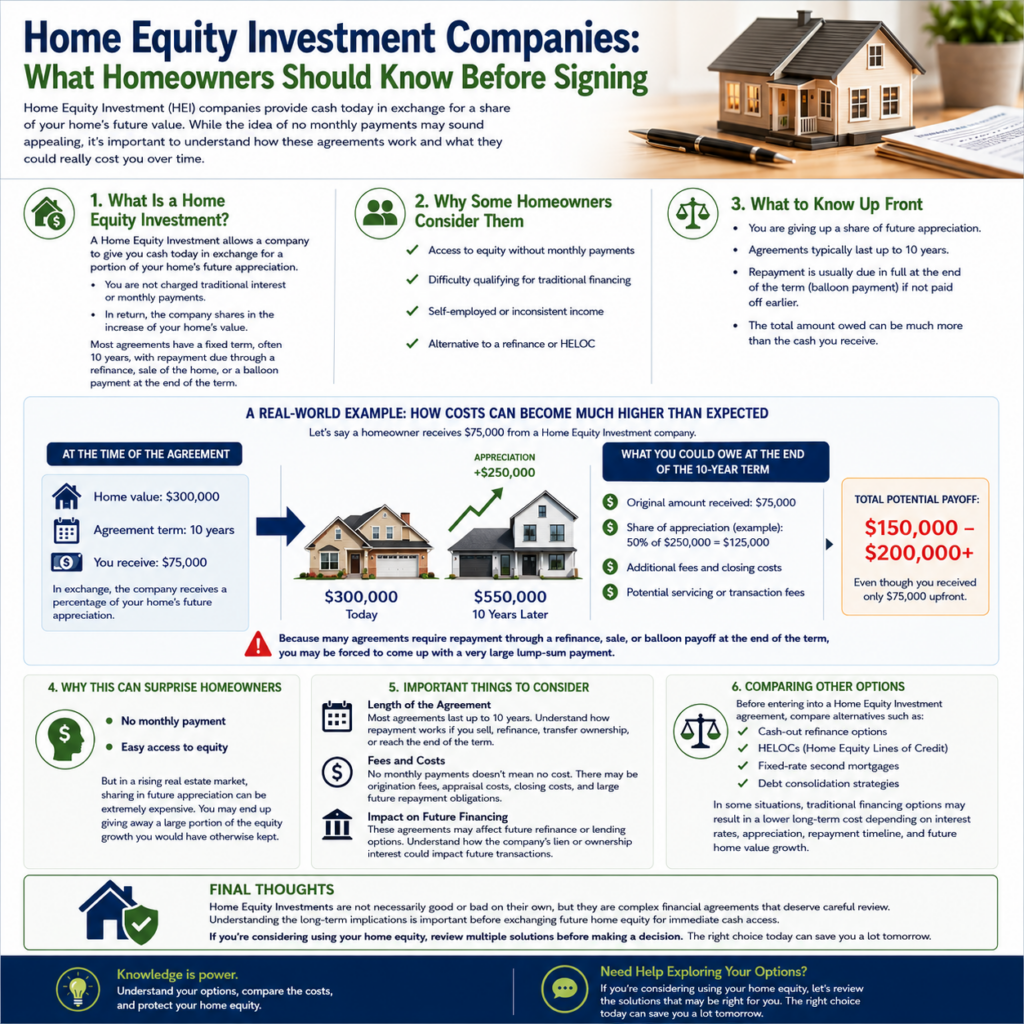
Home Equity Investment Companies: What Homeowners Should Know Before Signing
Homeowners today are seeing more advertisements from companies offering access to home equity without a traditional monthly mortgage payment.
These programs are often called Home Equity Investments, or HEIs.
While they may seem appealing at first glance, it’s important for homeowners to fully understand how these agreements work before signing anything.
What Is a Home Equity Investment?
A Home Equity Investment allows a company to provide a homeowner with cash in exchange for a portion of the home’s future value.
Unlike a traditional mortgage or home equity loan, the company is not charging interest in the traditional sense. Instead, they participate in a share of the home’s future appreciation.
This means if the property increases in value over time, the amount owed back to the company may increase significantly as well.
Many of these agreements also have a fixed term, often around 10 years, where the homeowner is eventually required to repay the investment through:
- a refinance
- selling the property
- or a balloon-style payoff at the end of the agreement term
Why Some Homeowners Consider Them
Some homeowners explore these options because they may:
- Want access to equity without monthly payments
- Have difficulty qualifying for traditional financing
- Be self-employed or have inconsistent income
- Want an alternative to a refinance or HELOC
For certain homeowners, these agreements may provide short-term flexibility.
A Real-World Example of How Costs Can Become Much Higher Than Expected
Let’s say a homeowner receives $75,000 from a Home Equity Investment company.
At the time of the agreement:
- The home is worth $300,000
- The homeowner signs a 10-year agreement
- In exchange for the upfront cash, the investment company receives a percentage of the home’s future appreciation
Unlike a traditional mortgage or HELOC, there may be no required monthly payment during the term of the agreement.
At first, this can sound attractive to homeowners looking for short-term financial flexibility.
However, many homeowners do not fully realize how expensive the final payoff can become years later.
Example of the Long-Term Cost
Fast forward 10 years.
The homeowner’s property value has increased from:
- $300,000
to: - $550,000
That means the home appreciated by:
👉 $250,000
Depending on the terms of the agreement, the homeowner may owe:
- The original $75,000 received
- A negotiated percentage of the appreciation
- Additional fees and closing costs
- Potential servicing or transaction fees
In some agreements, the repayment amount could exceed:
👉 $150,000 to $200,000 or more
— even though the homeowner originally received only $75,000 upfront.
And because many agreements require repayment through:
- a refinance
- sale of the home
- or balloon payoff at the end of the term
…the homeowner may eventually be forced to come up with a very large lump-sum payment.
Why This Can Surprise Homeowners
Many homeowners naturally focus on:
✅ no monthly payment
✅ easy access to equity
But the long-term appreciation sharing is where these agreements can become very expensive in a rising real estate market.
In areas where home values appreciate significantly over time, homeowners may end up giving away a large portion of the equity growth they would have otherwise kept.
Comparing Other Options
Before entering into a Home Equity Investment agreement, homeowners may also want to compare alternatives such as:
- Cash-out refinance options
- HELOCs (Home Equity Lines of Credit)
- Fixed-rate second mortgages
- Debt consolidation strategies
In some situations, traditional financing options may result in a lower long-term cost depending on:
- interest rates
- appreciation
- repayment timeline
- future home value growth
Because every situation is different, reviewing multiple options before signing any agreement tied to home equity is extremely important.
Final Thoughts
Home Equity Investments are not necessarily good or bad on their own, but they are complex financial agreements that deserve careful review.
Understanding the long-term implications is important before exchanging future home equity for immediate cash access.
If you’re considering using your home equity and want to better understand your options, it may be helpful to review multiple solutions before making a decision.


