
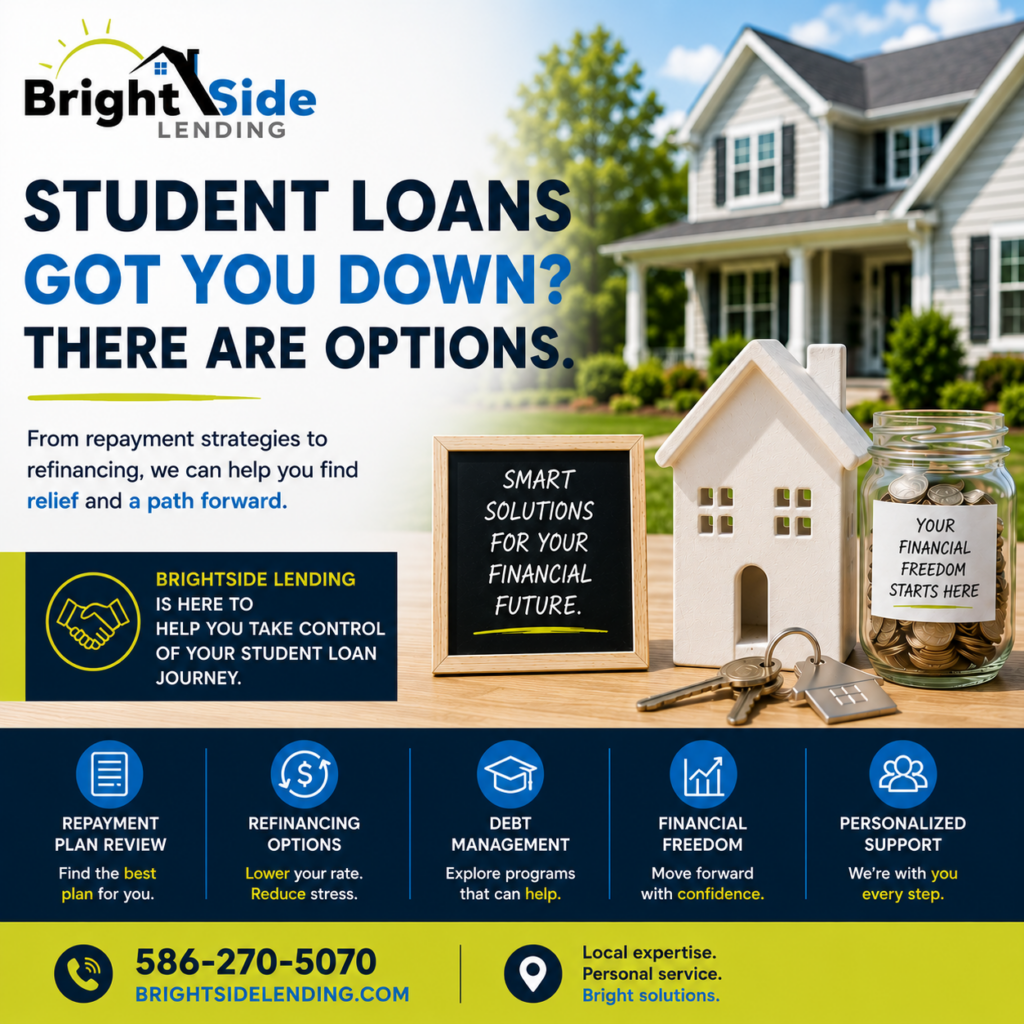
Can You Buy a Home in Michigan With Student Loan Debt?
For many potential homebuyers, student loan debt feels like a roadblock to homeownership.
In fact, one of the most common questions we hear at BrightSide Lending is:
“Can I still buy a home if I have student loans?”
The short answer is yes.
Having student loan debt does not automatically prevent you from qualifying for a mortgage. In fact, many first-time homebuyers purchase homes every year while carrying student loan balances.
The key is understanding how lenders evaluate that debt and how it affects your overall financial picture.
Student Loans Are More Common Than You Think
Millions of Americans carry student loan debt, and mortgage programs are designed with that reality in mind.
Whether you owe $10,000 or $100,000 in student loans, the amount of debt alone does not determine whether you qualify for a mortgage.
Instead, lenders focus on your ability to comfortably manage your monthly obligations.
What Lenders Really Look At
When evaluating a mortgage application, lenders typically consider:
- Your income
- Your credit history
- Your employment stability
- Your available assets
- Your debt-to-income ratio (DTI)
Your student loan payment becomes part of your monthly debt obligations and is factored into your DTI calculation.
For example, if your monthly income is $6,000 and your total monthly debt payments are $2,400, your DTI would be 40%.
Different loan programs allow different maximum DTI ratios.
What If My Student Loans Are Deferred?
Many borrowers assume deferred student loans are ignored during the mortgage process.
Unfortunately, that is not always the case.
Most mortgage programs require lenders to account for student loan payments even if the loans are currently deferred, in forbearance, or on certain income-driven repayment plans.
The good news is that there are guidelines that may allow lenders to use your actual payment amount in many situations.
This is one reason it’s important to speak with a mortgage professional early in the process.
FHA vs. Conventional Loans
Both FHA and Conventional financing can be excellent options for borrowers with student loan debt.
FHA Loans
FHA loans are often popular among first-time buyers because they may offer:
- More flexible credit requirements
- Lower down payment options
- Competitive mortgage terms
Conventional Loans
Conventional loans may offer advantages for borrowers with:
- Strong credit scores
- Stable income
- Lower overall debt levels
The best option depends on your individual situation rather than your student loan balance alone.
Down Payment Assistance May Help
Many Michigan homebuyers assume they need to choose between paying down student loans and saving for a down payment.
Fortunately, there may be programs available that help with down payment and closing costs.
These programs can reduce the amount of cash needed upfront and help buyers achieve homeownership sooner than they expected.
Many buyers are surprised to learn that student loan debt doesn’t necessarily prevent them from qualifying for a mortgage. In some cases, borrowers with significant student loan balances still qualify because lenders focus heavily on monthly payment obligations rather than total debt alone. That’s why getting pre-approved early can provide clarity and prevent unnecessary delays.
Don’t Assume You Won’t Qualify
One of the biggest mistakes prospective buyers make is eliminating themselves before speaking with a mortgage professional.
We’ve helped buyers who thought:
- Their student loan debt was too high
- Their credit score was too low
- They didn’t have enough saved
- Homeownership was years away
In many cases, they were much closer than they realized.
The Bottom Line
Student loan debt does not automatically disqualify you from buying a home.
The right mortgage strategy depends on your income, monthly obligations, credit profile, and long-term goals.
If you’re wondering whether student loans are affecting your ability to qualify, the best first step is having a conversation and reviewing your options.
At BrightSide Lending, we’ll help you understand exactly where you stand and create a plan that works for your situation.
Ready to find out if homeownership is closer than you think? Contact BrightSide Lending today and let’s explore your options.


